GPT-5.6 Is Three Models, and Most of Us Can't Use It Yet
OpenAI previewed GPT-5.6 not as one model but as three — Sol, Terra, and Luna — priced up to 5x apart and mapped to different kinds of work. The more interesting parts are the pricing strategy underneath it and the fact that it went to the US government before it went to you.
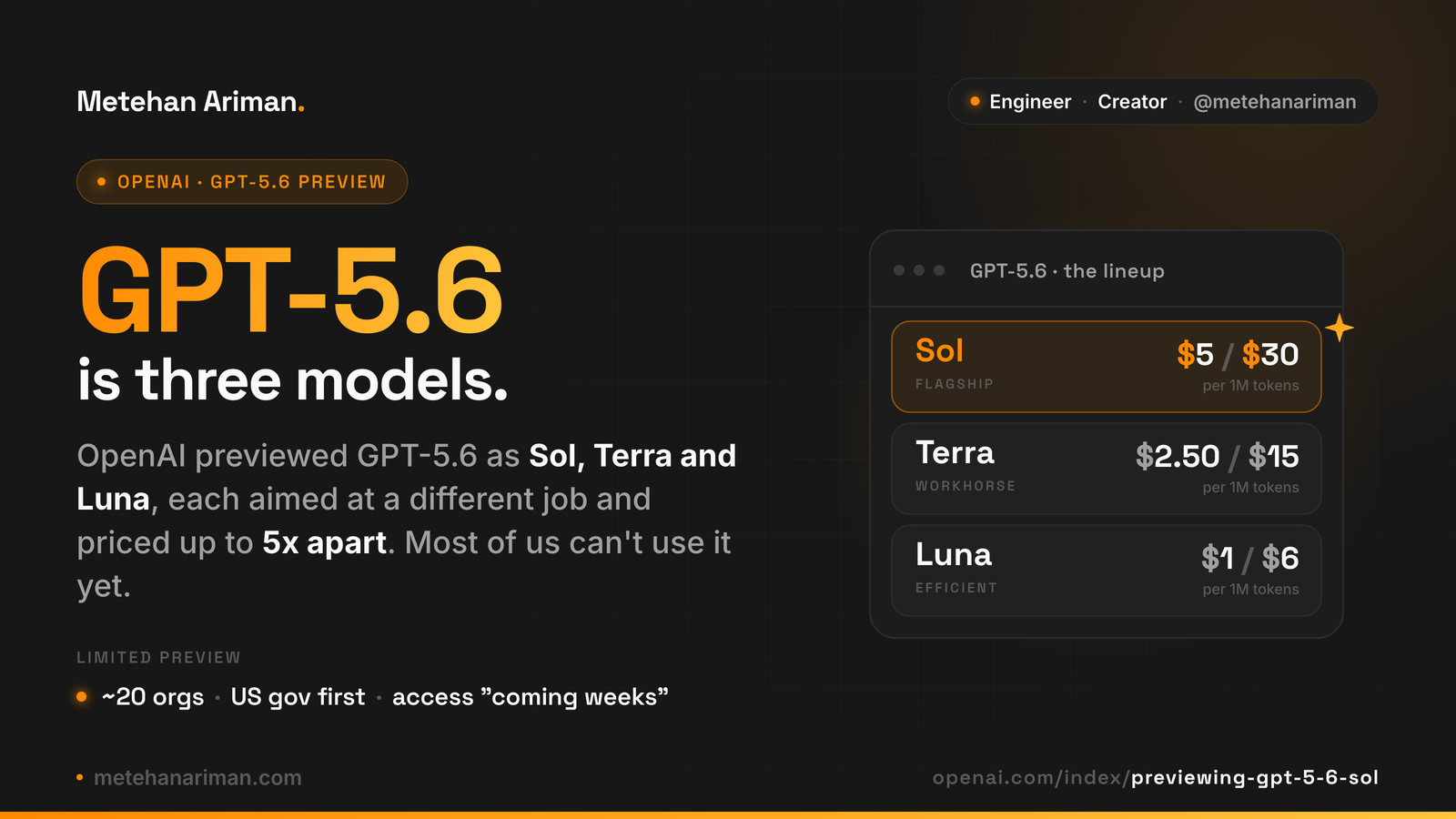
OpenAI previewed GPT-5.6 this week, and the first thing worth noticing is that it isn’t a model. It’s three.
Sol, Terra, and Luna ship as one family, but they’re priced up to 5x apart and each is pointed at a different kind of work. That framing is more interesting than any benchmark chart, and it comes with a catch most of the coverage is skipping: you almost certainly can’t use it yet.
Both of those are worth sitting with.
Three models, three jobs
Here’s the lineup, with pricing per million tokens (input / output):
- Sol — the flagship, aimed at the hardest problems: complex coding, security research. $5 / $30.
- Terra — the workhorse for high-volume business work: support, internal tools, document analysis. $2.50 / $15.
- Luna — the cheap, fast one for everyday tasks like summarizing, drafting, and routine automation. $1 / $6.
Same family, one preview, and a bill that moves 5x from bottom to top depending on which one you point at a task.
The product isn’t a model. It’s a price ladder.
The usual model launch gives you one thing and asks you to route everything through it. GPT-5.6 does the opposite. It hands you three price-performance points and, implicitly, a table of which work goes where.
That’s a pricing decision as much as a model release, and it’s a smart one. Most teams were already doing this by hand — sending cheap tasks to a small model and saving the expensive one for the work that needs it. OpenAI just made the routing part of the product and named the tiers.
The honest read is that this rewards people who think about their workload, not just their model. Send everything to Sol and you’re overpaying for summarization. Send everything to Luna and you’ll feel it on the hard 20%. The savings live in matching the model to the job, and now the menu is explicit.
Speed became its own tier
One detail that’s easy to miss: OpenAI is launching Sol on Cerebras at up to 750 tokens per second in July.
That’s not a quality number, it’s a latency number, and it signals that inference speed is becoming a product axis rather than an implementation detail. For anything interactive — an agent you’re watching work, a tool a user is waiting on — throughput at that level changes what feels possible. I haven’t been able to test it, so treat the figure as OpenAI’s claim, not a measurement. But the direction is clear.
The catch: a preview, and the government saw it first
Now the part the pricing tables gloss over.
GPT-5.6 is a limited preview. Access is going to roughly 20 organizations to start, and OpenAI shared the models and its release plans with the US government before making them available. General access is “coming in the coming weeks,” with no firm date.
So for almost everyone reading this, GPT-5.6 is a launch you read about now and use later. That’s worth stating plainly, because “OpenAI shipped GPT-5.6” is doing a lot of quiet work in most headlines. It didn’t ship. It was previewed, to a short list, after a government review.
Whatever you make of that as policy, it’s becoming a pattern. Frontier models increasingly arrive through narrow previews and government channels before they reach a public API. That’s a different release shape than the one we got used to, and it’s worth tracking on its own.
What to actually watch for
When general access opens, the benchmark chart won’t be the interesting part. Two things will:
- Whether the tiers hold up in practice. Is Terra actually good enough for the high-volume work it’s priced for, or does real use push you back up to Sol?
- How fast the preview becomes real. “Coming weeks” has a wide range, and the gap between preview and availability is itself a signal about how these launches work now.
I’ll run all three on tasks I actually care about once I can. Until then, this is reporting, not a review — and the most useful thing in it is probably the reminder to read “shipped” carefully.
If you get access before I do, I’d like to know which tier surprised you.