GPT-Live Teardown: OpenAI Killed Turn-Taking, but the Smart Model Is Still GPT-5.5
On July 8 OpenAI made GPT-Live the default voice engine of ChatGPT. The real story isn't a smarter voice, it's a new architecture: a fast full-duplex model owns the conversation and delegates the hard reasoning to GPT-5.5 running behind it.
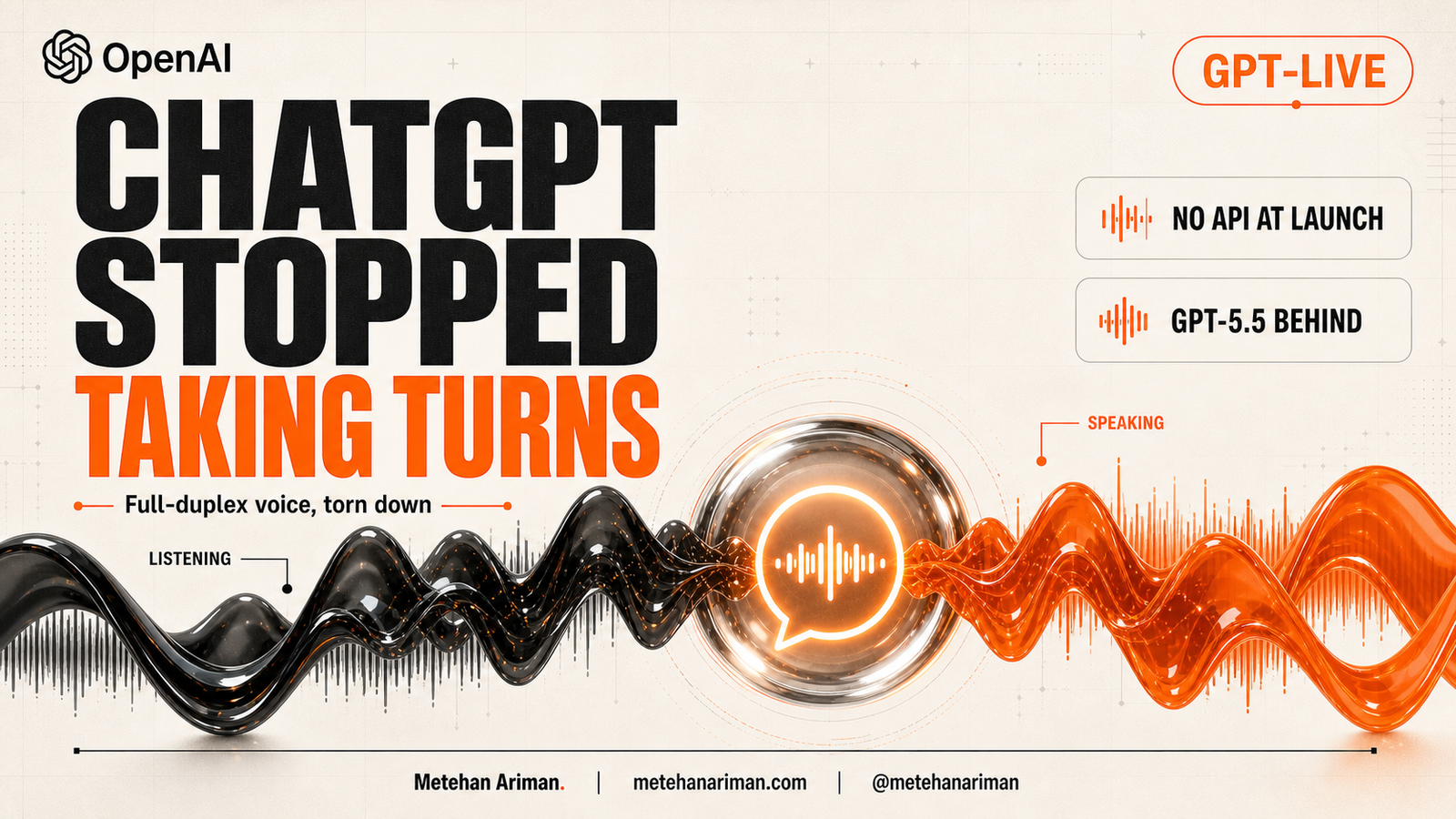
On July 8, OpenAI made GPT-Live the default voice engine of ChatGPT — iOS, Android, and web, everywhere at once. The demos everyone clipped were the “mhmm” moments: the model murmuring while you talk, cutting in mid-sentence, sounding less like a walkie-talkie and more like a person. Cute. Also not the story.
The story is that turn-taking is dead, and OpenAI shipped an architecture, not a smarter model, to kill it. I didn’t get API access, so everything here is read off OpenAI’s launch material and the first wave of reporting. Treat it as a teardown of what they claim, not a review of what I tested.
What actually shipped
Two models, one default swap.
GPT-Live-1 is the new default for Go, Plus, and Pro. It’s a full-duplex voice model with nine remastered voices, and this is the part worth underlining: it delegates the hard work to GPT-5.5 running behind it. GPT-Live-1 mini powers the free tier: same architecture, smaller, and it replaces the old voice mode for everyone. Multiple languages at launch.
OpenAI says 150 million people use ChatGPT Voice and Dictation every week. That’s their number, not an independent count. But if it’s even close, the engine under a huge amount of daily voice usage just changed overnight, with no announcement most users will notice.
Three generations of voice, in one diagram
To see why full-duplex matters, line up how voice assistants have actually worked.
Cascaded — the Siri era. Three separate models passing notes: speech-to-text, then a language model, then text-to-speech. Every handoff adds lag. This is why old assistants felt slow and stilted. You weren’t talking to a mind, you were waiting on a relay race.
Turn-based — Advanced Voice Mode. One speech-native model. Faster, because there’s no relay. But it still waits for your silence before it starts thinking. It’s polite. It’s also rigid. You take a turn, it takes a turn, like a radio call.
Full-duplex — GPT-Live, now. Audio in and audio out at the same time. There are no turns at all. The model is listening and speaking in the same window.
Here’s the part that reframes the last five years of voice UX: that awkward pause in every voice assistant you’ve ever used? It was never the model being slow to think. It was the architecture forcing a turn boundary. Remove the boundary and the pause disappears.
The decision loop is the actual product
OpenAI describes GPT-Live as making a choice many times per second. While you’re still talking, it’s continuously deciding: speak now, stay quiet, drop an “mhmm,” cut in, or call a tool.
That per-second loop is what buys the behavior people are clipping. You can interrupt mid-sentence and it adjusts. It stays silent while you pause to think instead of jumping in. Live translation rides the same timing machinery. All of this per OpenAI, of course. No one outside has stress-tested it yet.
So the “mhmm” is a demo trick. The decision loop underneath it is the thing they built.
The pattern nobody’s talking about: delegation
This is the slide I’d pin to the wall if I were building anything with voice.
GPT-Live is not the smart model. It owns the conversation — fast, always responsive, keeping the audio flowing — but when a question needs real work, it hands off. Web search, deep reasoning, agentic tasks: those go to GPT-5.5 running behind the conversation, at Instant, Medium, or High reasoning. The frontier model does the heavy thinking and passes the answer back into the live audio.
Receptionist in front, frontier model in the back office.
Say that out loud and it stops sounding like a quirk of one product and starts sounding like the default design for every voice agent that ships after this. A cheap, fast model owns latency and turn-taking; an expensive, slow model owns correctness; the fast one decides when to wait for the slow one. That’s the pattern. GPT-Live is just the first mass-market thing built on it.
The catches (because it’s day one)
The launch is thinner than the demo, and it’s worth being specific about the gaps:
- No API. “Planned soon.” On day one, builders can’t touch any of this. The most interesting architectural idea of the launch is the one you can’t build on yet.
- No video, no screen share. Advanced Voice Mode had both. GPT-Live shipped without them.
- Language parity is incomplete. Multiple languages are supported, but not all at full parity yet.
- Every benchmark is OpenAI’s own. The GPQA, BrowseComp, and τ³-Voice wins are all vendor-reported. Zero independent runs so far.
None of this makes the launch fake. It makes it day one. Strong claims, no outside verification. Read the numbers accordingly.
Verdict
GPT-Live isn’t a smarter model. The smart one is still GPT-5.5, sitting behind it. What actually shipped is a new interaction architecture: a fast model owns the conversation and delegates the hard work to a frontier model it can call mid-sentence. The voices are nicer, but that’s a footnote. The pattern is the launch, and the pattern outlives the demo.
The thing to watch is the API. The day it ships, every voice agent gets rebuilt on top of this shape, because the shape is better than what everyone’s doing now.
If you were handed full-duplex voice with a frontier model on call behind it, what would you build first?
Reporting, not firsthand testing. Sources: OpenAI’s GPT-Live launch page, plus launch-day coverage from MarkTechPost, TechCrunch, and SiliconANGLE (July 8, 2026).